- Home
- Getting Started
- Learn at Home
- How Much Space for a Dance Pole?
How Much Space Do You Really Need for a Home Dance Pole?
By Susan Peach
While there are no hard and fast rules about how much space you should allow when installing your home dance pole, the general guideline is to allow a minimum of 6 feet or 2 metres all around your pole. But actual requirements can vary depending on your height, your current level and your future goals. This guide explains space requirements for safely installing a dance pole at home, taking these factors into account.
Why "It Depends" Isn't a Cop Out
Most of the advice you'll get if you ask how much space you need to install a home dance pole revolves around the general guideline of 6 feet, or 2 metres. But if you're reading this, you're probably looking for something more than just general guidance. You want to know how much space YOU need.

You're right to push for a more personalized answer, because pole dancers are individuals with different bodies, different starting places and different goals.
That's why an advanced, competitive pole dancer might need 8 feet of clearance on all sides, while a 4-foot radius (or even less in a pinch) might work just fine for a beginner.
With that in mind, let's explore the important variables, examine some options, and look at a few examples to help you understand how much space you'll need for your specific situation.
Your Height Matters
Assuming you'll be practicing in bare feet, your height is the one factor you can't change*, so let's consider this one first.
Space requirements for a dance pole are based on the fact that this sport involves spins, climbs and tricks that require your body — or parts of it — to be extended away from the pole. All other factors being equal, if you're a petite 5 feet in height, your "safe zone" is going to be smaller than someone who's a foot taller.
Arm and leg length matter too, since you'll often have one or the other extended during spins and tricks. So the taller you are, and the longer your limbs, the more space you should allow.
*The exception is if you dance in heels, or plan to incorporate these in the future. Given that you can easily add another 6-8 inches or more in height and leg length with a pair of platform shoes, this is an important consideration you should take into account.
But your height is just one factor to consider. Petite + advanced might actually require more space than tall + beginner. That's why it's important to consider the impact of your level on your need for space.
Beginner, Intermediate or Advanced?
When thinking about your current level, a good rule of thumb is that the closer you are to "beginner," the less space you'll need. Conversely, allow more space the more advanced your level is.
If you're just getting started with pole dancing, you'll likely have an easier time setting up your home dance pole in a smaller area. That's because beginner moves typically require less space than intermediate and advanced tricks.
For example, most spins at the beginner level will have both your legs on the pole, and your body will tend to hang down the pole vs away from the pole. And for single-arm spins, it's a simple matter of keeping your outside arm closer to your body — perhaps placed on your hip, behind your head, or down at your side — instead of extending it all the way out to the side.
Once you're working on higher levels tricks, you may have one or both legs off the pole while you spin, with your body and legs held away from the pole instead of close to it. Combine this with hand and grip changes while in motion, as well as inversions and laybacks, and the need for a wider margin of safe space becomes much greater as your skills increase.
Looking Ahead — What's Your Goal?
Your current level is helpful in understanding how much space you're going to need around your dance pole today, but you'll probably also want to account for where you're aiming to be in the future. That's where your goals factor into the space equation.
To be clear, if you're a beginner, there's no need to give up on your dream of installing a home dance pole because you don't have enough space for advanced tricks. In other words, your future goals won't be a limitation until you get closer to achieving them. But it's something to think about because even though your goals don't impact your space requirements today, this will become more important the more you progress.
On the other hand, if you're on the cusp of progressing to the next level, then your available space may be more of a limitation if it doesn't allow you to progress beyond where you are today. This scenario deserves more thoughtful consideration, since you may not want to go to the trouble of buying and installing a home dance pole, only to find that you don't have enough room to work on the moves that will take you to the next level.
So How Much Space Do You Need?
Here's where it gets personal, because there's no one-size-fits-all answer. Let's explore some examples to help make the decision-making process more concrete.
First of all, if you've got a space that allows for a full six feet (approx 2 metres) of clearance all the way around your pole, you probably don't need to worry. In this case, you can be fairly confident that you'll have enough room to safely train up to an advanced level.
If you're petite (under 5'4" or 163 cm) and a beginner, you're probably good with about four feet (1,2 metres) of clearance around the pole, at least for now. To help you visualize it, that's an 8' x 8' (2,5 square metre) room with no furniture or other obstacles, just open space. Keep in mind that you'll want to monitor how this amount of space is working for you as you progress to more intermediate moves.
If you're already at an intermediate level, and you have a good sense of spatial awareness and decent control, you'll likely find that many tricks, spins and lifts at this level can be done with about the same amount of clearance. Obviously you'll need to be selective about which tricks you do, since space requirements will be greater for some moves.
If you're taller (say, 5'5" to 6' or 165-183 cm) and working at a beginner to intermediate level, five to six feet of clearance is better. For an intermediate to advanced pole dancer in this height range, seven to eight feet is ideal, especially if you're going to be doing moves like full body spin.
How to Measure Your Space
Once you've figured out how much space you need to be able to safely install and use a home dance pole, it's important to measure correctly.
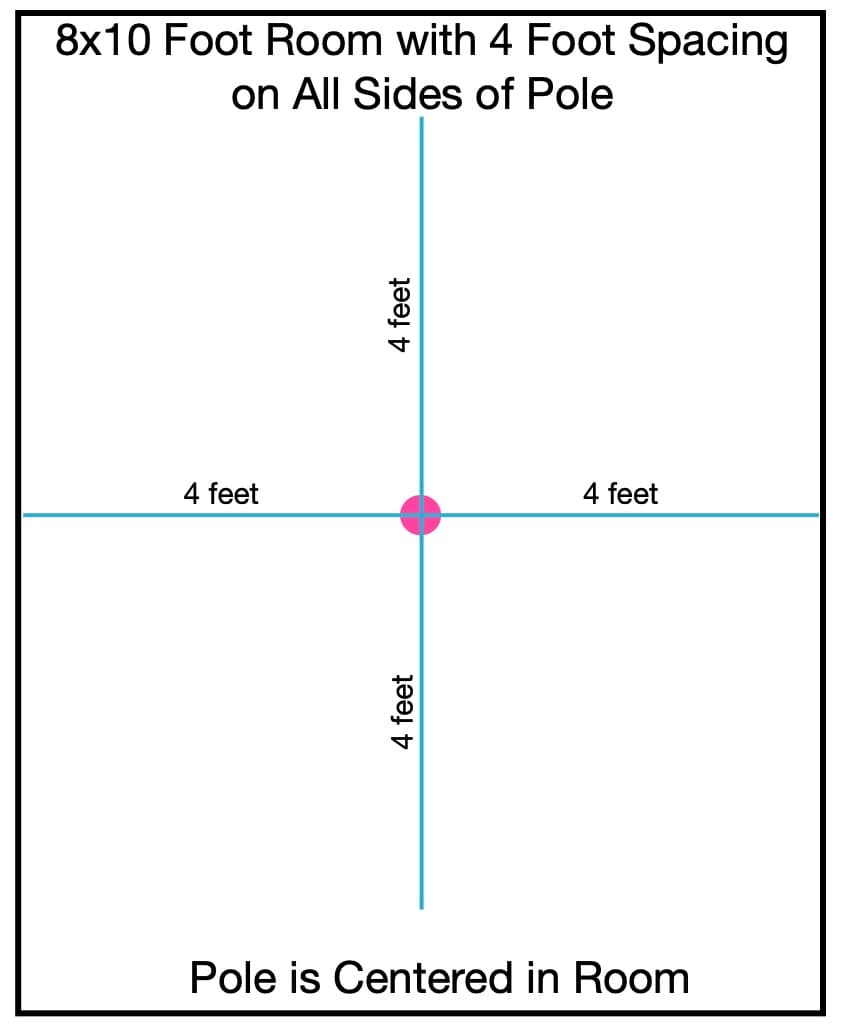
As an example, if you've calculated that 4 feet will be adequate clearance for your needs, keep in mind that means 4 feet of clear space all the way around the pole. In other words, you are measuring radius, not diameter.
The two diagrams below show two different options for how you could install your pole in a room that measures eight feet by ten feet. The first diagram shows the pole (the pink circle) centered in the room. Your minimum 4 foot clearance is represented by the blue lines. In this case you'll have 4 feet of clearance on two sides and 5 feet on the other two sides.
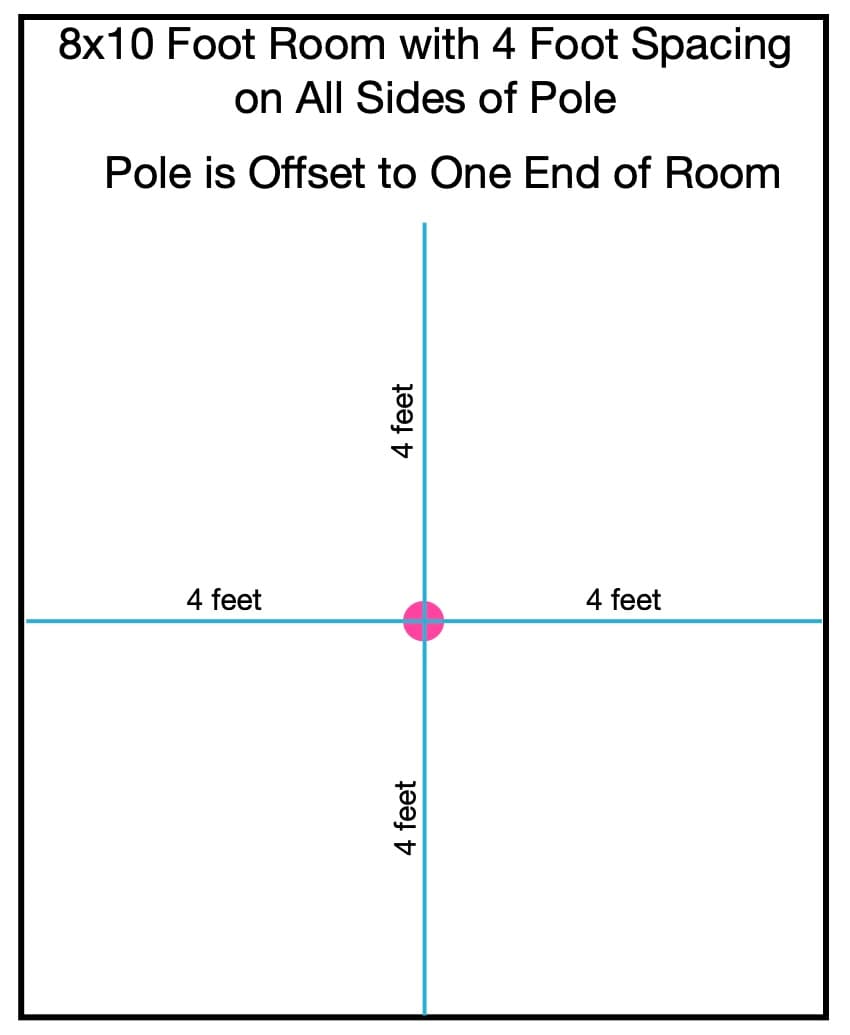
The second diagram shows an offset installation which allows for 2 feet of extra space at one end of the room. The tradeoff is that you'll have a maximum of 4 feet of clearance on 3 sides, with one side having six feet of clearance from the center of the pole. On the plus side, you might have room to tuck a small table into one corner to hold your water bottle, pole cleaner, etc.
The other thing to be aware of when measuring your space, is anything in the space that you can't or don't want to move. Furniture is the most common item you'll need to take into account, but even items that aren't on the floor, like knick knacks, table lamps, and artwork you have on the walls can impact your clearance when you're doing spins or other airborne moves.
Working with What You Have — What to Do if Space is Tight
If you've read this far and are losing hope that you have enough space to safely install and use a home dance pole, this section is for you.
Even if your available space is less than ideal, you may still be able to practice pole at home. You may not have access to the full slate of tricks, as many do require a fair bit of clearance especially at the advanced level, but you can almost always find enough to work on to make installing a home dance pole worthwhile.
Suggestions For Beginners
If you're a beginner on a tight space budget, there are quite a few compact moves you can learn and practice in a tight space. Floor-based turns, pivots, body waves, hip dips and slides can all work, as can pole sits and basic spins like the chair spin and the fireman spin. With all of these moves, your body stays close to the pole so you'll need less clear space around you to practice them safely.
Your Pole Pal has actually danced in some pretty tight spaces — most memorably while warming up for a demo in a space that wasn't much bigger than a closet — so it's entirely possible if not ideal. The important thing to keep in mind is that the more restrictive the space, the more aware of your surroundings you'll need to be. For example, if your bedroom is doubling as your pole room and there's a dresser two feet to your left, it may be best not to extend your leg during a spin!
Suggestions for Intermediate-Advanced Pole Dancers
For more advanced pole dancers, many types of climbs and holds can be practiced with relatively little clearance. And if your space limitations are due to furniture more than the actual size of the room, you might find you can do some tricks if you climb higher up your pole before you start. In other words, once you're above the height of your sofa, you'll reclaim the floor space it's taking up.
The good news for all levels of pole dancers is that even if you have to install your home dance pole in an area with relatively little clearance, you'll soon find that you develop a good sense of spatial awareness and will usually be able to modify many moves and tricks to accommodate your available space.
A Few More Suggestions for Tight Spaces
Conditioning exercises on your pole are a good option if space is at a premium, as most of these can be done in a very tight space. Think pole pull ups, leg lifts, knee tucks, bicep pulls, and shoulder shrugs, just to name a few.
The type of pole you choose to buy can also give you some flexibility in dealing with a space crunch. Opting for a removable pole (either friction mount or semi-permanent with an extra mount purchased) will allow you to use your pole in more than one area of your home.
That way, if you have a larger room in your house that's not suitable for installing your pole on a permanent basis (like a formal living room or the kids' play area), you'll have flexibility to move the pole there temporarily if you want to practice moves that require more space than where you usually have your pole.
Example Scenarios
To help make things a bit more clear as you estimate your own space requirements for a home dance pole, let's look at a couple of examples that are a bit more concrete.
Mary is a total beginner
She wants to take up pole dancing primarily for the fitness benefits, but there aren't any studios in her town. After some research, she's decided to learn to pole dance at home. She plans to buy a home dance pole and sign up for some online lessons so she'll have a structured learning plan to follow.
Mary has a spare room in her house that she was using for storage, and she wants to install a semi-permanent pole because she feels it's the safest option without having to drill holes in the floor. The room is small, about 8' x 9', but she's moved everything that was in the room to her basement so the entire space is clear.
The dimensions of the room mean that she'll have 4 to 4.5 feet of clearance around the pole. This is less than the generally accepted guidance of 6 feet or 2 metres, but Mary feels comfortable with that because:
- There's no furniture in the room so the space is entirely clear
- She's a beginner so the moves she's going to be learning don't require as much space
- She's not overly tall at 5'5" (1,65 metres)
- She feels comfortable with making concessions as she improves, ie if there are some intermediate or advanced moves that require more space, she'll focus on other tricks that she can do safely in the space she has available.
Emma is an intermediate pole dancer
She's been taking regular studio classes for about 6 months and wants to be able to train at home as well. Her goal is to continue improving at a steady pace. Her pole training has replaced her gym workouts, which she never really enjoyed and only did to stay in shape.
Emma is fairly tall at 5'11 (1,8 metres) and she knows she'll need adequate space to practice more advanced tricks as she progresses. But she lives in a one bedroom apartment so her options are limited.
With furniture taking up most of the space in her bedroom, and no spare room or basement, she decides to buy a removable pole with a friction pad. She feels this is her best option because she'll have flexibility as to where she installs it for each session. Plus, she can take it down when she's not training, allowing her to maximize the use of her limited space.
The living/dining area in Emma's apartment is fairly generous at 20' x 15', so there's lots of space for a dance pole in theory, but she knows she has to take the furniture into account.
She identifies a couple of spots in this space where she can install her pole: one that's smaller but more convenient because it doesn't require her to move any furniture; and another that can be made larger by moving her couch and coffee table back. She'll use this option for working on tricks that need more space to practice safely, and the smaller area for conditioning exercises and moves that don't require much space.
Need More Home Pole Dancing Help?
If you live in an apartment or condo, or even a house that you rent, find out what type of pole is best so you don't cause damage to the floor or ceiling. There are a number of options depending on your ceiling type, how much space you have, and your training needs.
If you're feeling stuck about how to learn on your own, or wondering how to structure your at-home pole program, this guide to online pole dancing lessons can help you choose an affordable option that's right for you.
If you just don't have the space to install a home dance pole, you might be wondering if it's possible to take online pole classes without a pole. Spoiler alert: it's definitely not ideal, but it can be a good way to get started if you have no other option. Alternatively, it's a way to dip your toe in the water if you're not sure if all this measuring and calculating is worth the trouble.
Learning at home is very different from taking studio classes. That's why Your Pole Pal has created an entire section just on home pole dancing, with additional guides to help you succeed and stay safe. Check them out whenever you have questions or need a little extra support.

Was this page helpful? Make YourPolePal.com your preferred source of pole dance info on Google, so it'll be easier to find more useful pole guides like this one.


Susan Peach was an early pioneer in pole fitness and is now the voice behind Your Pole Pal, a long-running resource for the pole community. With more than 30 years of experience teaching pole, dance, and fitness, she helps newcomers navigate the world of pole with confidence.

What's New?


-
How Old Do You Have to Be to Take Pole Dance Classes?
Sep 06, 26 04:12 PM
 Get clear on minimum age limits for pole dance classes, and why waivers, studio policies, and parental consent all matter.
 -
How Hard is Pole Dancing? A Beginner's Reality Check
Aug 30, 26 05:42 PM
 Pole dancing is hard, but beginners can start at any fitness level. See what to expect, why technique matters, and how progress gets easier with practice.
 -
Pole Dancing for Beginners - What to Expect and FAQs
Aug 23, 26 08:35 PM
 Learn what to expect as you begin your pole dancing adventure, including answers to the most common questions from new pole dancers.
 -
London Pole Studios & More | Pole Dancing in England
Aug 21, 26 06:12 PM
Discover top pole studios in London as well as pole dancing classes throughout England. Find local studios near you to start your pole dancing adventure today. -
Getting Started with Pole Dancing: A Beginner's Guide
Aug 02, 26 11:02 PM
 New to pole dancing? Learn about home vs studio options, pole parties, safety basics and more so you can plan your pole dancing journey right, from the start.
Your Pole Pal loves to have fun, but she also has to earn a living, right? That's why you'll see ads on this site. She may also earn commissions on some of the products you'll see here, but there's never any cost to you since the advertisers pay for these.
The income generated through these means helps ensure Your Pole Pal can devote the time to providing you with all the free information & resources you'll find on this website.
Want to learn more? Your Pole Pal invites to you read her full advertising disclosure. You know...in case you haven't read enough legalese lately. 😉