- Home
- Getting Started
- Studio Classes
- Studio Safety
Pole Studio Safety & Red Flags
By Susan Peach
A safe pole studio is usually obvious long before you'll ever have to rely on a crash mat, but professional equipment and certified instructors are only part of the picture. What happens at the front desk and in class also reveals a lot about how a studio prioritizes safety. This guide walks you through what to look for during your initial visit and through your first class, helping you evaluate a studio's safety culture with greater confidence.
Inside This Guide
This pole studio safety guide is a very detailed read. If you'd like to jump to a specific section on the page you can use the links below.
Why beginners often miss safety red flags
Before your first class — Policies that reflect a safety-first culture
Safe equipment & setup — Poles, mats & maintenance
In-class safety — Instructors, certifications & safe instruction
Safety checklist — Includes downloadable PDF
Why Beginners Often Miss Safety Red Flags
Evaluating pole studio safety isn't as easy as it seems, especially if you're new to pole. After all, if you don't even know what safety looks like in a pole studio, how are you supposed to evaluate it?
As a new or prospective student, it’s easy to assume that the studio knows best and whatever safety protocols they have in place are adequate and appropriate. But this isn't always true.
Case in point: When Your Pole Pal opened her pole studio back in the early 2000's, there was no such thing as a pole crash mat.
At that time, it was the norm to not have proper safety mats in studios, but not because it was considered safe to teach without mats. Rather, pole mats just weren't on the radar back then.
These days, using crash mats in pole studios, particularly for airborne moves and tricks, is a given, and Your Pole Pal would absolutely be using mats as a studio owner today.
This guide offers concrete ways that you can evaluate a studio for safety. We'll cover studio policies, equipment & setup, and in-class safety. You can even download a free PDF checklist that you can use to easily evaluate any studio you visit, according to the safety points presented on this page.
Look for the green and red flags to help you quickly pick out safety signals and warnings as you read.
Red flags describe situations that may be unsafe or that require caution.

Green flags point out signs that indicate a studio is safety-focused.
Before Your First Class Even Starts
There's a lot you can discover about how seriously a studio takes its safety obligations before you even touch a pole.
Safety starts with transparency and clear communication. These build trust, and trust is a piece you absolutely need to have in place if you're going to feel safe at a pole studio.
A transparent studio will have easy-to-understand policies regarding membership options, registration and class booking, wait lists, payment, cancellations, refunds, and of course, safety protocols. This information should be clearly communicated to all new students before they arrive for their first class.
Policies that Reflect a Safety-First Approach
Safety information should be highlighted apart from other studio policies, rather than tucked in between class pricing and wait list policies.
Ideally, a studio will publish clear safety rules & explanations on their website, in a new student welcome package, and/or in a high-visibility location in the studio. If you can't find this information, you should definitely ask about it, but proceed with caution if a studio doesn't make its safety policies easy to find, or doesn't seem to have any.
So what should you be looking for in terms of policies that will tell you a studio takes safety seriously?
Caps on Class Sizes
A safety-focused studio will have caps on class sizes for the simple reason that an instructor cannot safely and effectively teach pole if the class size is too large.
The instructor isn't just leading a warm up and demonstrating moves. They are responsible for ensuring that students learn and practice correct technique and perform the moves safely, and this requires supervision. It's also important that the instructor be able to provide individual attention to students who are having difficulty, as well as spotting as needed.
Even though it may occasionally be frustrating not to be able to register for a class you want to take because it's full, it's important to remember that limits on class sizes are there to help ensure that all students have a safe and positive learning experience.
|
|
Appropriate caps on class sizes according to physical space, number of poles, and instructor ability. |
|
|
No class size policy, or one that allows an unsafe number of students. |
Clear Pole Sharing Policy
Studios should have a clear policy on how many students are permitted to share a pole, and under what circumstances.
Particularly in beginner classes, too many students sharing a pole can lead to frustration over not getting enough pole time. This can also present a safety issue, because if you have to wait too long for your next turn on the pole, your muscles may start to cool down and your risk of injury goes up.
Pole sharing can also lead to class sizes that are unsafe. A policy that permits two or even three students per pole can effectively double or triple the number of students in a class, which can mean a class size that's too large for the instructor to safely teach.
However, if pole sharing is managed appropriately, it's not necessarily a safety risk. In fact there are times when pole sharing might even provide greater safety.
Advanced students practicing high-level tricks typically require short recovery breaks between attempts. Alternating with a "pole buddy" can give both students the rest they need to avoid overuse injuries. Particularly if there is an assistant or apprentice instructor present to help with teaching and supervising a larger group, pole sharing at higher levels can be entirely appropriate.
The critical thing to look for here is a clear policy that spells out whether or not pole sharing is practiced, and if so, the circumstances under which it's permitted as well as the maximum number of students who may share a pole.
|
|
Clear policy on pole sharing that is appropriate to each class and level. |
|
|
No pole sharing policy, or one that allows for more than two students per pole. |
Prerequisites & Booking Rules
This is another policy that can feel a bit limiting at first, but again, rules around class prerequisites and who can book into certain classes are there for your safety.
You might feel that you can skip the mandatory orientation or even the entire beginner level because you're comfortable with movement, are already very fit, and you want to get straight to the more challenging tricks.
But it's important to remember that even if you have previous dance experience, or you come from a strong fitness background, there will more than likely be gaps in your knowledge that are specifically related to pole dancing.
Pole dancing is progressive, meaning it builds on foundational skills. So if a studio requires you to complete an orientation class or start with a beginner class, it's because they want to make sure you have the specific pole-related information, skills and knowledge you'll need to be able to safely move through their class levels.
|
|
Clear system of levels along with a policy on how students progress through these. |
|
|
Studio has no clear policy on prerequisites, or allows students to skip levels without evaluation. |
Pole Hygiene, Grip Products & Lotions
Rules around how often poles are cleaned and disinfected show that the studio is concerned with limiting the spread of colds, infections, skin issues and the like. It's an unfortunate reality that viruses and bacteria are easily passed from person to person when sharing equipment, so having a cleaning and disinfecting policy is a must.
A studio may limit the use of pole grip products to specific types or brands, depending on what kind of poles are used in the studio or what type of class is being taught. This could be because different grip products have different ingredients that work best with certain poles finishes. Other ingredients can render a particular pole finish too "grippy" for spins or too slippery to safely do release moves.
Occasionally, an instructor or student may have an allergy to an ingredient in a particular grip product, which is another reason for rules around cleaning and disinfecting the poles between users.
Finally, it's common for studios to have a "no lotion" policy, which usually applies to both hand and body lotions. Not only can these make the poles slippery for you and other students, the oils can also affect the finish on some types of poles, making them harder to clean and disinfect.
|
|
Pole cleaning and disinfecting policy, and clear rules around use of pole grip, lotions and other skin products. |
|
|
No clear policies on pole hygiene or skin products. |
Clothing & Shoes
Rules around clothing and shoes are likely to be level-specific rather than studio-specific.
Advanced classes typically require more skin exposure because you'll be relying on different contact points with the pole. For this reason, students may be required to wear tight crop tops or sports bras, along with shorts that meet a specific set of criteria (leg length and rise, for example).
For beginner classes the clothing requirements are usually more relaxed, but shorts and a tank top that are form fitting will often be specified. Loose clothing can be a hazard because it can get caught up between you and the pole even during basic moves. It also prevents the instructor from accurately assessing your form and technique.
Most beginner classes require bare feet for safety, though platform shoes may be permitted or encouraged after a certain level for exotic style classes.
For studios that do have heels classes, there are sometimes rules around which brands and styles are permitted. This is due to the fact that some cheaper brands are not as well-constructed and could put students at higher risk of injury through slips, twisted ankles, etc.
Ankle straps should be required on platform shoes, as these ensure your shoes stay securely on your feet. Slide platforms can be incredibly dangerous, not only because they lack proper ankle support but also because they could slip off during a trick and go flying across the studio. Obviously, this would be unsafe not only for you but for the other students as well.
|
|
Clear direction and explanation of appropriate clothing and footwear for each level. |
|
|
No guidance on what to wear and why, or policies that allow for unsafe clothing or footwear. |
Jewelry
It's very common for studios to require students to remove all jewelry during class time. This is to protect both the poles and your jewelry.
Rings in particular are a danger as they can scratch the poles, sometimes deeply, depending what a ring is made of and whether it has any stones set in it. Rings can also cause painful pinch-type injuries if your skin gets caught between your ring and the pole during a spin, for example.
On the flip side, rings can be easily damaged if worn while pole dancing, especially if they're made of softer metal like gold. And you definitely don't want to be spending your class time crawling around on the floor looking for a diamond that got dislodged from your engagement ring.
Some studios will allow certain types of jewelry like stud earrings, but even small earrings can come out during class. If you notice you've lost an earring, the class will likely come to a halt until it's found, wasting class time. And if you don't notice, someone could step on the earring which could result in an injured foot or a fall due to slipping.
Like rings, watches can both damage the poles and your skin, and can also suffer damage themselves. Necklaces and dangling earrings are at high risk of coming off or being damaged during spins, inversions and similar moves. For this reason, many studios simply have a ban on all jewelry during class time.
|
|
Studio has a clearly written policy on jewelry in class, including specifics of what is and isn't allowed and why. |
|
|
Policy on jewelry is vague or non-existent. |
Equipment & Setup
Physical safety is in some ways fairly easy to assess, but first you have to know what to look for. The equipment a studio uses, and how that equipment is maintained, are important indicators of a studio's safety culture.
When visiting a studio for the first time, you should be able to see the training areas and the equipment. Here are the things to look for, red flags that should caution you, and some helpful questions you can ask.
Dance Poles
There are lots of options available in dance poles today, from the material used (brass, stainless steel, chrome, silicone, etc.) to the diameter of the poles. Many studios use more than one kind of pole in order to give students more choices. But regardless of the type of pole a studio uses, safety is a non-negotiable.
Reputable Brands
The first thing you'll want to ask is what brand of poles the studio uses and why. Reputable dance pole manufacturers include X-Pole, Lupit, and Lil Mynx. These aren't the only ones, but they are the most popular in many parts of the world.
Less expensive poles purchased on Amazon or similar online marketplaces can be inconsistent in quality. They typically are not made for commercial use and the company is unlikely to warranty the product for studio use.
|
|
Studio uses poles from reputable brands; staff can identify which brand is used and why. |
|
|
Staff do not know which brand of poles are in the studio, or won't give a clear answer. |
Commercial Quality
Most dance poles manufacturers make poles for both home and studio use, so the next thing to check is that the poles are commercial quality, or studio grade.
Studio poles are typically sold with permanent ceiling and/or floor mounts, and are usually (though not always) single-piece construction. If the poles are multi-piece construction, they absolutely need to have metal connectors.
Studio poles might also be custom made for height, and should be reinforced if the studio ceilings are very high. Because reinforcement is typically done by adding a solid piece of metal inside the pole tubing, you won't know if it's there unless you ask.
In contrast, home dance poles frequently use a tension or pressure mount system, and are assembled in sections to allow for easier storage when not in use. While this is convenient and sufficiently safe for home use, multi-piece construction and pressure mount systems are not as safe in a studio setting where the equipment gets very heavy use.
|
|
All poles are commercial quality, intended for studio use, and are either permanently affixed to floor and ceiling or installed with commercial grade mounts. |
|
|
Use of plastic connectors in multi-piece poles; tension mounted poles are a caution, as these are not as safe as permanent installs. |
Mounts
You'll want to make sure the studio uses commercial grade mounts vs the less expensive mounts designed for home use. It may not be obvious to you what the difference is, so be prepared to ask about the type of pole mounts used.
Studio mounts are typically made of much stronger material and are designed for function rather than aesthetics. In contrast, home mounts are designed to be minimalist so they blend in, but they're not made to stand up to the kind of heavy daily use most studio poles get.
Below is just one example of what a home mount (on the left) looks like compared to a studio mount (on the right). Notice that the studio grade mount is made entirely of steel, with no plastic components.
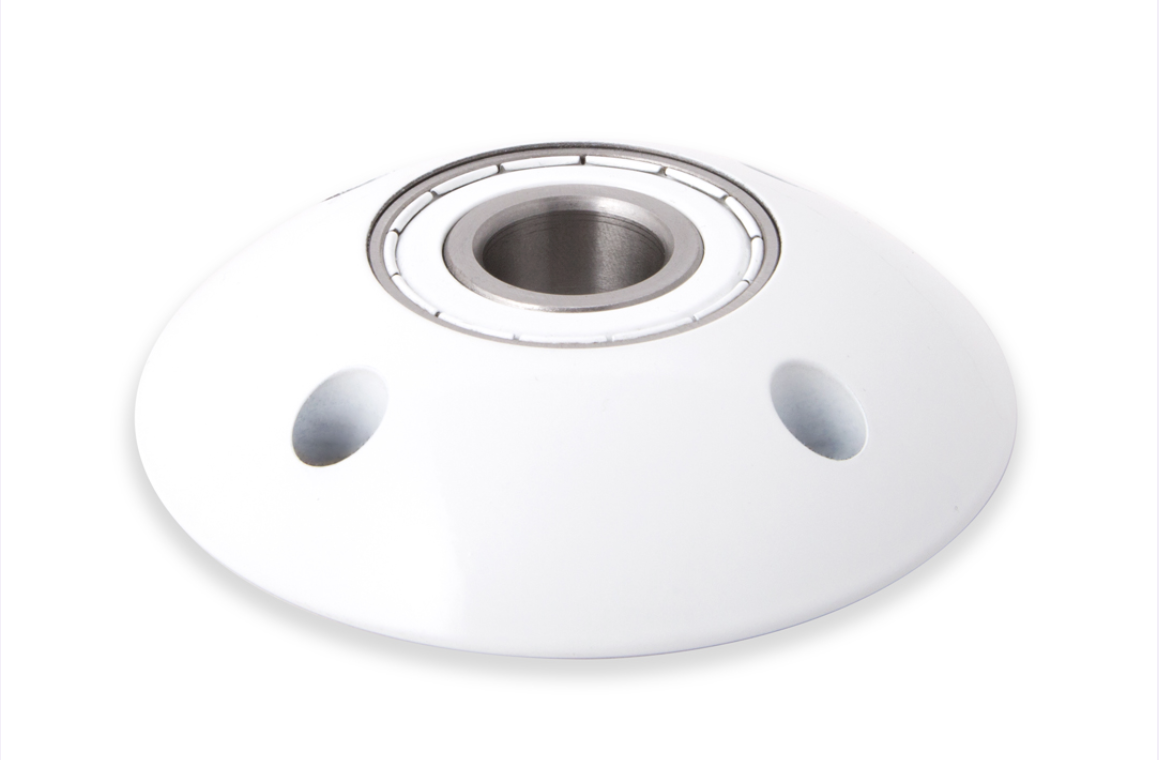 X-Pole Ceiling Mount for Home Use
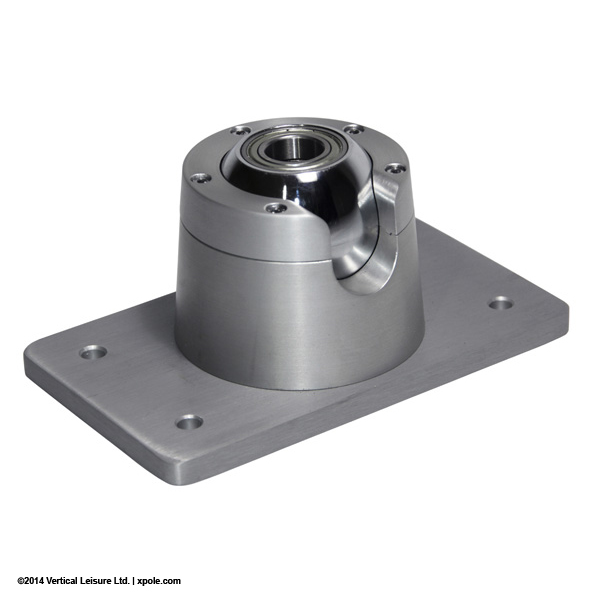 X-Pole Studio Grade Mount
|
|
Pole mounts are studio grade, steel construction |
|
|
Pole mounts have plastic parts or are intended for home use only. |
Pole Spacing
Finally, look at the setup in the pole room. There should be sufficient space between the poles, and between poles and walls or any other object. Students need to have enough room to move around the pole, as well as do spins and tricks, without danger of hitting another student or something else in the room.
What's considered sufficient space? It's difficult to give a hard number for this, because everyone's height, leg length, etc. is different. Also, more space is typically required for advanced tricks than for beginner moves.
As a general rule however, there should be an absolute minimum of 5-6 feet or 2 about metres between poles and anything else in the room. This includes walls, furniture, sound equipment, etc. Some studios have as much as 8 foot spacing, which is ideal for studios that teach advanced tricks.
Rather that try to make a visual estimate, it's wise to ask a staff member how far apart the poles are during your initial visit. Not only should they be able to tell you, they should also understand the reason for your question, and be able to explain why they chose the spacing they did.
|
|
Minimum of 5-6 feet (2 metres) between poles or other objects in the room. |
|
|
Poles spaced closer together than 5 feet, or too close to walls or other equipment to allow for spins & tricks. |
Pole Safety Mats
These days, crash mats designed specifically for use with poles are widely available, so there's no excuse for workarounds like pieced together gym mats.
Pole mats can be round or rectangular, but they should fit snugly around the base of the pole with secure ties or grips. There should be no visible gaps or danger of the mats separating at a seam.
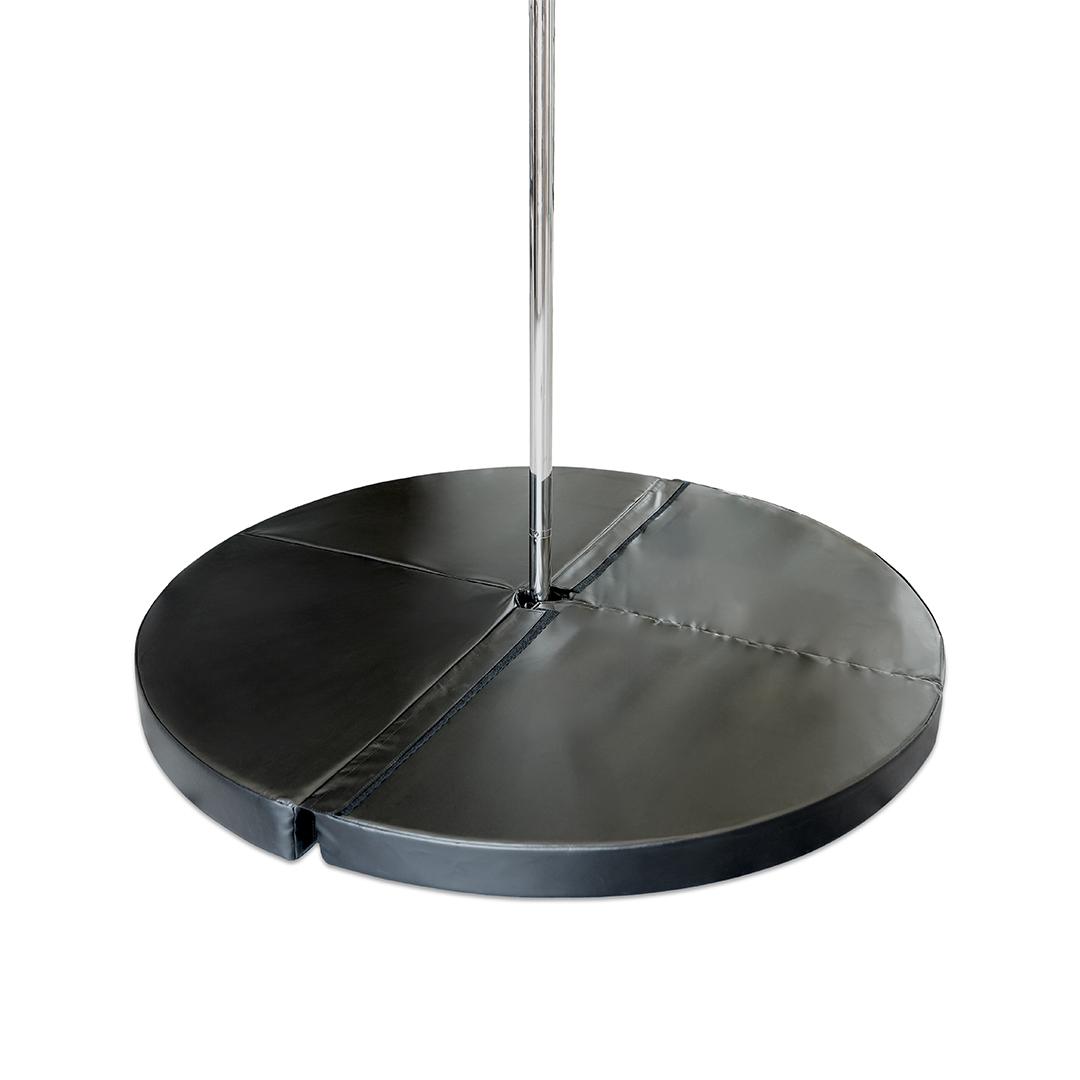 example of a round crash mat
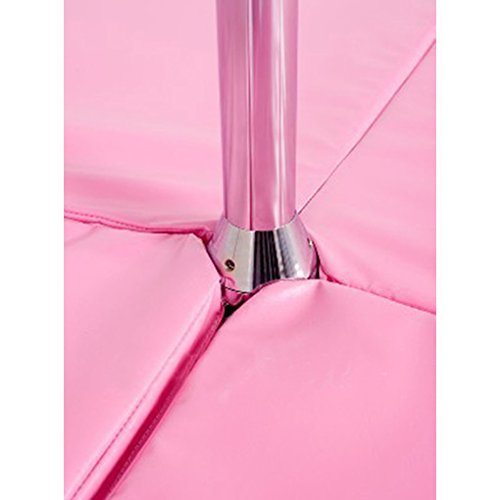 mat fits tightly around pole base
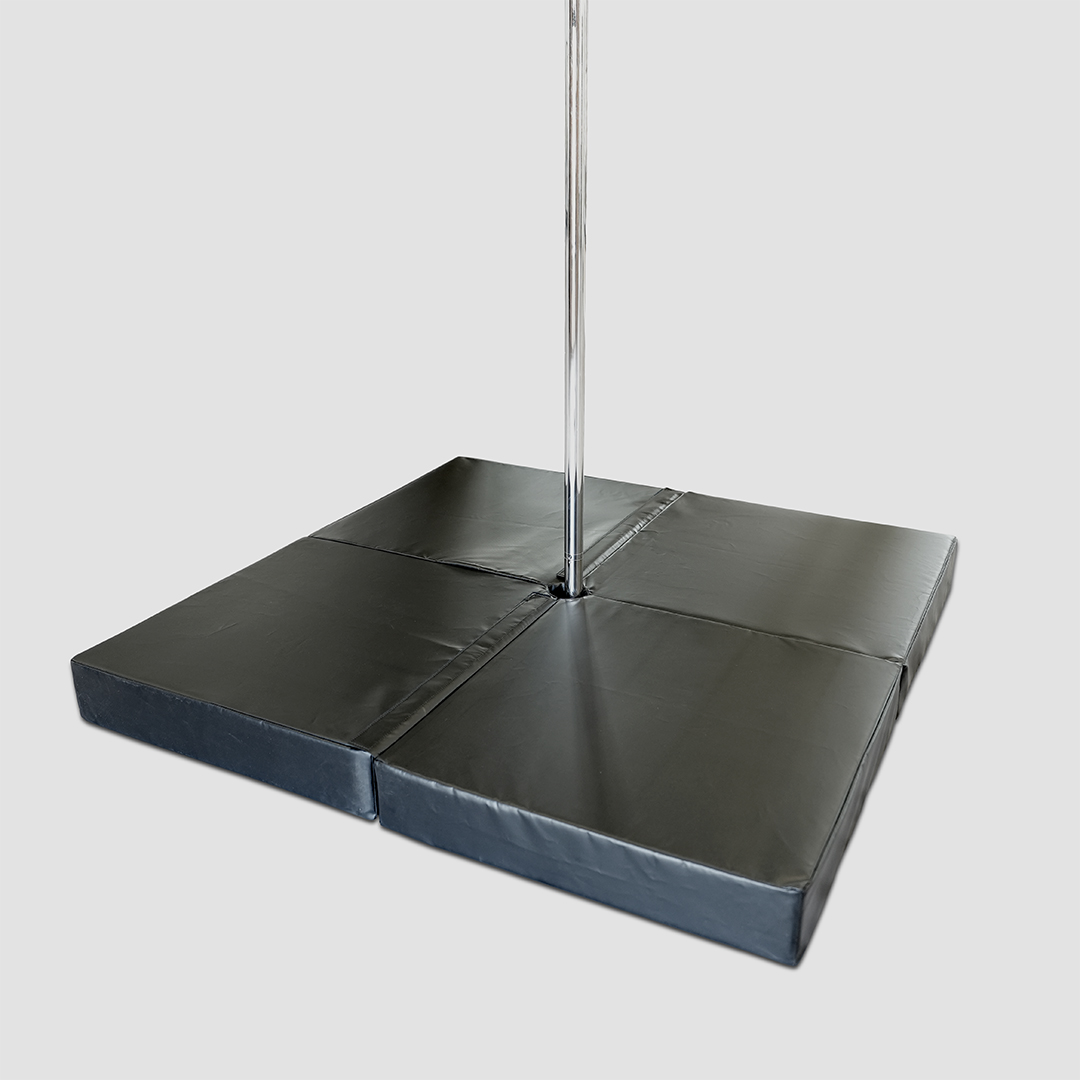 example of a square pole mat
Like dance poles, crash mats can vary in quality. Asking the staff what thickness the studio uses and why, can yield useful information. For most studios, safety mats that are 4-6" thick are a good balance. This provides adequate cushioning in case of a fall, but isn't too bulky for use in beginner classes where a thicker mat is not usually required.
Keep in mind that the mats may be stored at the time you visit, since they may not be required for every type of class the studio offers. But if you don't see crash mats when you visit, you should definitely ask what kind of mats are used and if you can see them.
|
|
Every pole is equipped with its own correctly installed, pole-specific crash mat. |
|
|
No crash mats, or use of mats not designed for pole dancing. |
Cleanliness and Maintenance
Having proper equipment is important for safety, but so is maintaining that equipment in good working order. Cleanliness is also related to safety in ways you might not realize at first.
Equipment Maintenance & Repair
It may not be obvious to you whether or not the studio's poles and mounts are in good condition, so once again, a question can be helpful here. But rather than asking if the studio has a maintenance schedule, a better approach is to ask what that schedule is.
The first question is an easy yes/no answer, whereas the second question should draw out some details. If the answer is somewhat vague, like "of course we keep the equipment in good repair," or "if something breaks we fix it right away," be cautious as this may indicate lax standards or a lack of attention to prevention.
Here are some specific questions you can ask that require more than a yes or no answer:
- How often are the poles and mounts inspected for excessive wear or damage?
- How often are the poles and mounts tested and tightened if necessary?
- How often is routine maintenance done and what does this consist of?
- Are there any items or parts that you repair or replace proactively on a schedule?
- How do you keep track of when inspections, maintenance, repairs, and replacements are done?
Keep in mind that a dance pole consists of not only the pole itself, but also the mounts, mounting screws or bolts, and bearings if spinning poles are used.
Crash mats should also be kept in good repair. If you see mats in the studio when you visit, check to make sure they aren't showing signs of excessive wear like rips or tears in the fabric covering. These can be a tripping hazard, and the wear may point to something you can't see, which is a mat that may not have the same cushioning it did when it was new.
Also look for signs of wear in terms of mats that don't appear to be securely fixed in place. Loose ties or worn fasteners can allow a mat to move or separate unexpectedly.
|
|
Clear responses to maintenance-related questions; studio has a proactive maintenance policy; equipment appears to be in good repair. |
|
|
Vague or unsatisfactory answers to questions about inspections and maintenance of equipment; visible signs of excessive wear or disrepair. |
Cleanliness
Cleanliness isn't just about appearances, it's also a matter of safety.
Of course you'll want to see clean poles, floors and mats when you tour the studio. But in terms of safety, you'll also want to see pole hygiene supplies like disinfectant and cleaning cloths in the pole room.
Floors or crash mats that are dirty, dusty or sticky due to spills can contribute to slips or falls. Poles that are not disinfected and cleaned regularly can harbor germs and spread illnesses among staff and students.
A clean studio is also a strong trust signal, especially for new students who are still evaluating whether or not the studio is a good fit for them. It's not unreasonable to draw conclusions about how safe a studio is based partly on its overall cleanliness. After all, if cleanliness isn't a priority, perhaps safety isn't either.
|
|
Poles, floors and mats are clean; disinfectant & cleaning cloths available in pole room. |
|
|
Studio spaces are visibly dusty or dirty; no cleaning supplies in pole room. |
Reporting Protocols
Closely related to equipment maintenance is how the studio manages concerns that are raised by students.
There should be clear policies in place for anyone — instructors or students — to report dirty, damaged or faulty equipment, and it should be easy to do so. Ideally, the studio will welcome all safety-related reports and take action on these right away.
Equipment that presents a safety hazard should be identified with signage or other clear indicators, or ideally removed from the studio until it can be repaired and safety reinstalled.
Finally the studio should have a policy for logging not only inspections and maintenance, but also reports of unsafe situations, including accidents.
|
|
Studio welcomes reporting of equipment in need of repair or cleaning and maintains inspection, maintenance and incident logs. |
|
|
Indifference to reports of safety issues; no logs are kept, or these are incomplete. |
In-Class Safety
The instructors are likely the studio staff that you'll be interacting with the most, and they carry primary responsibility for ensuring a safe environment in class. From certifications to warmups and spotting, how the instructors carry out their job is critical to how safe a studio feels.
Instructor Certification
Not all pole instructors have taken a certification course, and not all studios require their instructors to be certified. This doesn't necessarily mean that the quality of instruction is unsafe, but certification does give you some assurance that an instructor has received appropriate training and that the studio recognizes the importance of properly trained instructors.
Certifications are often displayed on a studio's website, and/or in the studio itself. If a studio doesn't discuss instructor certification on its website or in its marketing materials, you should definitely ask about this. If the instructors are not certified, it will give the studio an opportunity to explain why, and the answer may or may not satisfy you.
For example, it's entirely possible that an instructor has spent years as a successful high-level pole competitor, has a degree in education, and holds both personal training and first aid certifications. You might feel comfortable taking classes from this instructor, even if they don't hold a certification in pole dance instruction specifically.
Of course it's much more common that a pole instructor will have undergone formal pole-specific training and received a certification. But as long as an instructor is not misrepresenting their qualifications by saying they are certified when they aren't, there is no legal requirement that they have a certification in order to teach pole in the way that say, a medical degree is required in order to practice medicine.
That said, if certification is important to you, it's totally appropriate to ask to see proof of the instructor's training and qualifications. A professional instructor will not be offended by this request, and a studio should be willing and able to back up their claims around instructor training in order to put new students at ease.
|
|
All instructors have a teaching certification or equivalent training & experience that you are comfortable with. |
|
|
Instructors or studios cannot show proof of certification when asked. |
What Makes a Good Pole Instructor?
Certified or not, there are certain skills that all pole instructors should have:
- Technical Skills — the ability to do pole moves and tricks competently. While an instructor does not need to be at an advanced level in order to teach, they should be very competent at the levels below where they are currently training. If an instructor appears to lack confidence, or seems to be learning along with the students, this is a sign that they may not be fully competent to teach at that level.
- Instructional Skills — the ability to convey essential information effectively to students. Being a good pole dancer and being a good instructor are two different things entirely. Instructional skills take time and training to develop, and even excellent instructors continue to develop their teaching skills. If you find yourself in a class with an instructor who is using videos as the primary instruction method, this is almost certainly a sign that the teacher lacks instructional skills, technical skills, or both.
- Safety Skills — this encompasses everything from injury prevention through proper warm up and training technique, to first aid training and knowing what to do in case of an accident or other emergency.
A good instructor is one of the most important parts of a safe pole experience, but there's much more to being a great teacher than safe instruction. Read the complete guide to what makes a good pole instructor.
What Does Safe Instruction Look Like?
There are so many components to safe pole instruction, most of which aren't obvious until they're pointed out. In other words, a safe class led by a skilled teacher should just feel like a great class. But if you're concerned about safety, you may find it interesting to know what's going on below the surface, so you can be alert for these in-class safety signals.
Safety Should Be Baked Into the Class Structure
A safe pole class needs to be long enough to allow time for a suitable warm up and cool down, in addition to the main part of the class where new material is taught and practiced. Most classes are 60 minutes in length, but up to 75 minutes is ideal, especially for intermediate and advanced level classes.
Classes that are less than an hour long can feel rushed because it's difficult for an instructor to provide a quality teaching experience if they don't have enough time to get through the material. In addition to demonstrating the moves and providing safe instruction, instructors also need to ensure each student gets enough individual attention.
When there's not enough class time, something is going to suffer. This might mean a shortened warm up, students who are frustrated because there's no opportunity to ask questions, safety information that gets missed, or no cool down at the end of the class.
|
|
Classes start on time and are long enough to safely cover all components including warm-up and cool-down. |
|
|
Classes are less than 60 minutes long, and/or habitually start late, resulting in reduced class length. |
Safety Policies Are Enforced
Studios have policies around things like class sizes, appropriate attire, and in-class behavior for safety reasons. But these policies are ineffective if they aren't enforced, and it's part of the instructor's job to do this.
Ideally, this should be done firmly but with tact, so students who are new or have made an honest mistake don't feel chastised.
This could look like giving a general reminder about the no jewelry rule at the start of class, instead of singling out a student who has forgotten to remove a ring; or asking a student to speak with the front desk staff if their name is not on the class list, instead of telling them they can't stay because the class is full and they didn't pre-register.
But if a student is bound and determined to wear slide platforms without the ankle straps that are required for safety, the instructor needs to be able to deal with this directly but respectfully. This might sound like, "I'm sorry but studio policy is that platform shoes must have ankle straps. This is for your safety and the safety of everyone else in the room. But it's totally fine for you to do the class in bare feet today if you don't have the right kind of platforms with you."
|
|
Instructor enforces safety policies when necessary, in a firm but respectful way. |
|
|
Instructor seems unaware or uncomfortable asking students to comply with safety rules. |
Technique & Injury Prevention Come Before Progression
A safety-focused instructor emphasizes proper technique and injury prevention over fast progression. Safe progression means mastering foundational skills first, and then building on these step-by-step.
But ensuring students have a solid grounding in prerequisite moves before trying more challenging versions isn't always easy. Some students are impatient or excited to be able to do more advanced moves. Others assume they're performing the move correctly when they aren't. In both cases, the student may think they're ready for harder moves when in fact they still have foundational skills to master.
In this case, it's part of the instructor's job to help students understand that fast progression isn't necessarily a good thing, and to redirect them to the skills they still need to work on.
On the flip side, a competent instructor will also never put pressure on students to progress beyond their current abilities when the student doesn't feel ready.
|
|
Focus is on technique, injury prevention & foundational skills for safe progression. |
|
|
Students are allowed to progress faster than is safe, or are pressured to move through levels without having mastered required skills. |
Modifications & Alternatives
Sometimes different bodies need different approaches to a particular move. Or modifications may be needed if a student has physical limitations due to an injury or disability.
Safe instruction requires that an instructor be able to adapt what's being taught so students who have limitations can be successful. Knowing how to modify a particular move, or being able to offer an alternative when necessary, is a skill that every competent instructor should have.
A really good instructor will also be able to normalize modifications and alternatives. This might look like offering simple modifications for every move, or letting all the students know that modifications can be given during the time the instructor is moving through the class to provide individual feedback and correction.
|
|
Instructor normalizes modifications and offers these proactively. |
|
|
Students feel singled out or embarrassed for needing modifications or adaptations. |
Spotting & Supervision
Knowing how to spot correctly is a non-negotiable skill that every instructor needs to have. Crash mats are an important piece of the safety equation, but they should never take the place of an experienced spotter, especially for advanced tricks.
Spotting helps ensure your physical safety, but it can also provide that little bit of extra support that's sometimes needed for you to trust that you can actually do the move. Imagine these two scenarios...
Scenario 1 — You're attempting your first layback alone at home
You're in a sit near the top of the pole, having worked all week on the climb and calming your fear of heights. Thighs crossed, legs locked, one hand on the pole and the other reaching vaguely behind and below you. You want to release your grip and lay back but your mind is screaming that you're going to fall and break your neck. Instinctively you grab the pole with both hands and quickly drop back down to the floor.
Scenario 2 — You're learning in the studio with an instructor spotting you
You're in a sit near the top of the pole. The instructor double checks your leg hold and says, "you're good to go," then places her hands on your back to provide support if you need it. There's a good quality crash mat below so you know you'll have a soft landing if anything goes wrong. You're still nervous, but this time you're able to let go of the pole and allow the instructor to guide you into your very first layback.
While the need for spotting may be minimal in a beginner class, appropriate supervision is always required. This is not to say that an instructor should be hovering over the students at every moment, but they should always be present in the studio for the entire duration of the class.
It only takes a second for an accident to happen, and if the instructor is out of the room at the time, their absence could delay the arrival of appropriate help. At the very least, if an instructor must leave the room, they should ask another instructor or staff member to step into the class while they're gone.
|
|
Instructors are confident when spotting and know how to do so correctly; appropriate supervision is provided for the duration of the class. |
|
|
Instructor don't provide spotting when required, or do so ineffectively; students are left alone at times, without instructor supervision. |
A Simple Safety Checklist
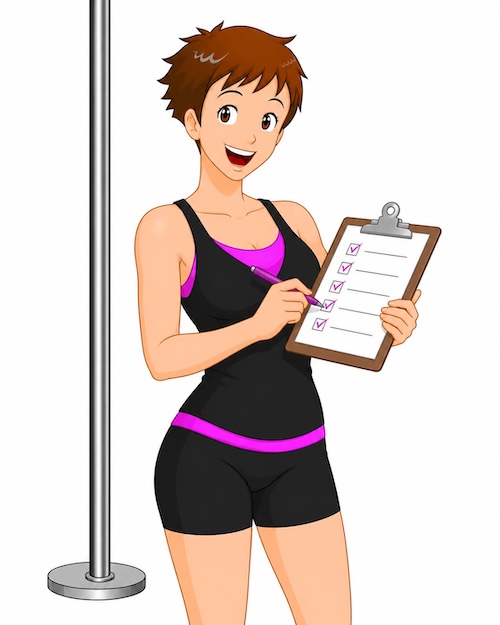
Below you'll find a summary of all the safety points covered on this page.
Use it during your initial visit to a studio, as well as in your first class or trial session. You should be able to check off most of the boxes.
If you prefer, you can download a PDF of this checklist to print out. Take it with you to the studio, or fill it out right after your visit, while all the details are still fresh in your mind.
1. Safety Policies
Studio has policies in place for:
☐ Class sizes
☐ Pole sharing
☐ Class prerequisites & booking rules
☐ Pole hygiene, including use of grip & lotions
☐ Clothing and shoes
☐ Jewelry
☐ Safety rules are provided to all students prior to first class
2. Equipment & Setup
☐ Poles are from a reputable manufacturer
☐ Poles are commercial grade vs home-use
☐ Commercial grade mounts are used
☐ Minimum spacing 5-6 feet (2 metres) between poles
☐ Studio uses crash mats
☐ Mats are specifically for pole, sufficiently thick, and of good quality,
☐ Mats and poles appear to be in good condition with no obvious signs of excessive wear
☐ Studio has a maintenance schedule in place for mats and poles, including mounts, bolts/screws and bearings if spin poles are used
• How often are the poles and mounts inspected for excessive wear or damage?
• How often are the poles and mounts tested and tightened if necessary?
• How often is routine maintenance done and what does this consist of?
• Are there any items or parts that you repair or replace proactively on a schedule?
• How do you keep track of when inspections, maintenance, repairs, and replacements are done?
☐ Disinfectant and cleaning cloths are present in the pole room
☐ Mats, floors and poles are clean
☐ Studio has an acceptable level of cleanliness in general
☐ Studio has reporting protocols for maintenance and cleanliness issues
☐ Studio maintains a log for inspections and maintenance, as well as for reports of unsafe equipment and accidents
3. In-Class Safety
☐ Instructors have a recognized certification or you are satisfied that they are competent
☐ Instructors have competency in: technical skills, teaching skills, safety skills
☐ Classes are minimum 60 minutes in length
☐ Instructors enforce safety policies in class
☐ Instructors focus on technique, injury prevention & safe progression
☐ Modifications and alternatives are normalized and offered proactively
☐ Instructors know how to spot correctly, as well as when spotting is necessary
☐ Supervision is always provided in class
More Helpful Guides
A safety evaluation is just one aspect of choosing a pole studio. You might also want to learn how to choose a pole studio that fits your goals, learning style, and comfort level.
Not sure which style of pole dancing best fits your goals? Learn about the three main styles so you can choose a studio that offers what you're looking for.
This guide to your first pole class explains what happens and how to prepare, and also covers pole studio etiquette.
Your Pole Pal has lots more guides about taking studio classes, to help you get informed and make decisions that work for you.
Frequently Asked Questions
What if a studio feels unsafe?
What if a studio feels unsafe?
You don't need a "good enough" reason not to return to any studio that doesn't feel safe to you. Your discomfort is reason enough, and you should trust your gut. If questioned, you only need to say that you didn't feel the studio wasn't a good fit, or that you're looking into other options as well.
A studio that feels unsafe doesn't mean pole isn't for you, it just means that particular studio may not be the best place for you to learn. If you have other studio options nearby, keep looking for the studio experience that feels safe and empowering for you. Because you're worth it.
What if a studio seems pretty safe overall, but also has a few red flags?
What if a studio seems pretty safe overall, but also has a few red flags?
No studio is perfect 100% of the time, and Your Pole Pal is not suggesting that every single item has to be checked off in order for a studio to "pass."
There will be scenarios where you need to use your judgement. For example, if a slightly damaged or worn crash mat is being used because the replacement mat that was ordered hasn't yet arrived, that's not a huge red flag. But a studio owner that is not interested in hearing your concerns about the poor condition of the mats is another matter.
A great way to resolve this dilemma is to bring up the issues that make you uncomfortable with the owner. If your concerns are validated and a plan is presented to resolve any safety issues to your satisfaction, you're likely to feel comfortable in this studio over the long run.
Should I leave a class if I feel unsafe?
Should I leave a class if I feel unsafe?
You are NEVER obligated to remain in any situation that feels unsafe, including a pole dancing class. Whether or not to leave the class is a personal decision, and depends very much on your assessment of the situation at the time. Your Pole Pal suggests that you trust your gut and make the decision that helps you feel more safe and less afraid or anxious.
If you decide to leave and you feel comfortable doing so, you may wish to report the issue to the owner. You can do this either as you leave the studio, or later via phone or email. An owner who is interested in creating a safety-first culture will want to know about whatever it was that made you feel unsafe in class.
What if the only studio in my area has too many safety red flags.
What if the only studio in my area has too many safety red flags.
This can be a difficult situation, because a studio should always strive for maximum safety, regardless of whether or not it has competition. In this situation you have basically three options:
1. Request a meeting with the owner to express your concerns and see how they respond. Openness and a willingness to make changes might earn the studio a second chance.
2. If you feel that you can work around the safety issues, you could choose to go ahead and sign up, knowing you'll need to look out for your own safety. If the issue is with the equipment however, this is probably not a wise move, since there's little you can do about that.
3. If commuting to another studio is not an option, you could consider getting your own pole and learning at home with one of the many online learning platforms that are available today. This comes with its own set of considerations, but it is a possibility that many people pursue simply because there is no studio near them.

Was this page helpful? Make YourPolePal.com your preferred source of pole dance info on Google, so it'll be easier to find more useful pole guides like this one.


Susan Peach was an early pioneer in pole fitness and is now the voice behind Your Pole Pal, a long-running resource for the pole community. With more than 30 years of experience teaching pole, dance, and fitness, she helps newcomers navigate the world of pole with confidence.

What's New?


-
How Old Do You Have to Be to Take Pole Dance Classes?
Sep 06, 26 04:12 PM
 Get clear on minimum age limits for pole dance classes, and why waivers, studio policies, and parental consent all matter.
 -
How Hard is Pole Dancing? A Beginner's Reality Check
Aug 30, 26 05:42 PM
 Pole dancing is hard, but beginners can start at any fitness level. See what to expect, why technique matters, and how progress gets easier with practice.
 -
Pole Dancing for Beginners - What to Expect and FAQs
Aug 23, 26 08:35 PM
 Learn what to expect as you begin your pole dancing adventure, including answers to the most common questions from new pole dancers.
 -
London Pole Studios & More | Pole Dancing in England
Aug 21, 26 06:12 PM
Discover top pole studios in London as well as pole dancing classes throughout England. Find local studios near you to start your pole dancing adventure today. -
Getting Started with Pole Dancing: A Beginner's Guide
Aug 02, 26 11:02 PM
 New to pole dancing? Learn about home vs studio options, pole parties, safety basics and more so you can plan your pole dancing journey right, from the start.
Your Pole Pal loves to have fun, but she also has to earn a living, right? That's why you'll see ads on this site. She may also earn commissions on some of the products you'll see here, but there's never any cost to you since the advertisers pay for these.
The income generated through these means helps ensure Your Pole Pal can devote the time to providing you with all the free information & resources you'll find on this website.
Want to learn more? Your Pole Pal invites to you read her full advertising disclosure. You know...in case you haven't read enough legalese lately. 😉